



Leaders frequently muse about innovation and growth when it comes to ensuring company success. And while peak performance matters, disregarding employee mental health can be a costly issue in all industries.
As it stands, mental health isn’t just a personal concern impacting individual wellness. Approximately 20% of all adults experience a mental illness in a given year, and personal struggles can unquestionably lead to professional difficulties. While we’ve made strides against the longstanding mental health stigmas, millions of employees are showing up to work battling depression, anxiety, trauma, substance use, and more.
Unaddressed mental health challenges can significantly impact employee performance and overall productivity. While there’s no one-size-fits-all solution, every workplace should aim to provide inclusive policies and benefits that support the diverse needs of its team.
Why Honoring Workplace Mental Health is No Longer a Luxury
Corporate mental health discussions were largely non-existent until about a decade ago. In most circumstances, employees were expected to show up for work, meet their expectations, and keep their personal feelings at home. If you had a mental health issue, it was solely your responsibility to manage it without involving anyone professionally.
However, this is no longer the case. People are far more outspoken about their mental health than ever before, and there are now global conversations about the effects of workplace burnout, toxic productivity, problems with ‘hustle culture’, and emotional wellness. Employers who disregard these crucial priorities risk losing high-quality employees and damaging their reputations.
Honoring mental health isn’t just a “nice” perk. It’s become more of an essential expectation in recent years. Research from the American Psychological Association’s 2023 Work in America Survey indicated that a staggering 92% of workers said it is important to work for a company that values their emotional well-being. 95% reported that they valued their company caring about the boundaries between work and personal time.
In addition, 33% of employees working for companies that failed to implement mental health measures indicated plans to look for a new job within the next year.1 In other words, if your company isn’t offering substantial breaks or adequate mental health support, there’s a chance your employees might be considering other options.
Financial Benefits of Workplace Mental Health Care
When executives hear “ROI,” they generally consider the concrete financial benefits for their company. They focus on measurables like revenue growth or improved margins. But mental health ROI is both tangible and intangible.
Here are some of the measurable returns:
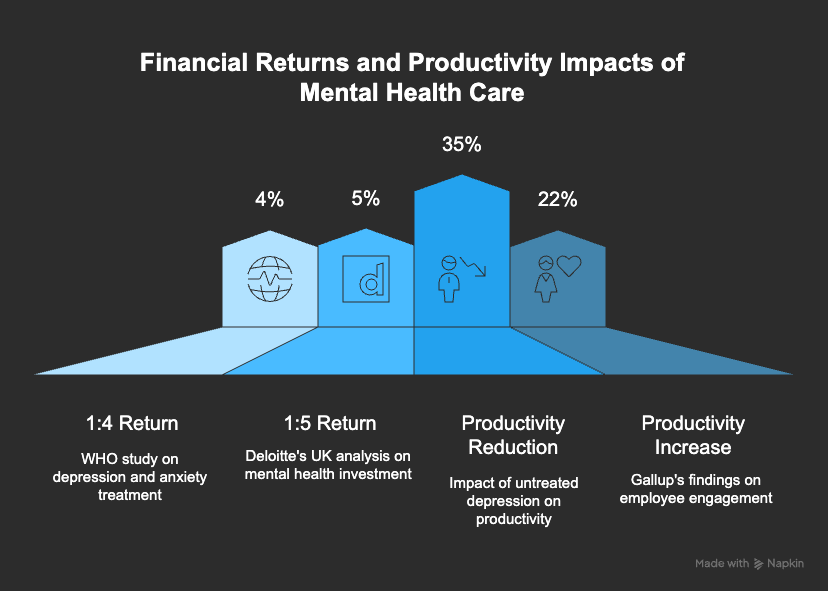
1:4 return: An old but large study, pioneered by the World Health Organization, found that every $1 invested in treating depression or anxiety led to a $4 improvement in workplace productivity and emotional well-being.2
1:5 return: Deloitte’s UK analysis found that employers investing in employee mental health can yield an average return of £5 for every £1 spent.3
35% reduction in productivity: The American Psychiatric Association found that untreated depression is responsible for a 35% decrease in professional productivity, contributing to over $210.5 billion in lost wages, medical costs, and overall absenteeism. On average, employees with depression miss 31.4 work days per year.4
22% higher productivity: Research conducted by Gallup examining 1.4 million employees discovered that companies with high levels of engagement toward employees have 22% higher productivity rates.5
While hard data provides one story, it’s also important to consider some of the more ephemeral benefits associated with investing in employee mental health. Here are some more essential factors worth considering:
Greater talent retention: When employees feel cared for and honored at work, they tend to feel more motivated and proud of their roles. They want to pour into their professional roles and may be less likely to leave the company prematurely. This absolutely saves companies money on recruitment and turnover rates.
Stronger professional reputation: Valuing employee mental health looks good for both employees and clients. Many consumers are socially conscious and want their money to go toward organizations that prioritize wellness.
Reduced absenteeism and presenteeism: When employees have support and resources in place to look after their mental health, they may miss work less frequently. When they are at work, they’re more likely to be engaged and productive with their time.
Ensuring Your Mental Health Investments Achieve a Strong ROI
Not all mental health programs yield the same returns. The most successful efforts are those that are accessible, inclusive, and tailored to actual employee needs. With that, it’s important to consider your current workplace culture, any existing deficits, and the specific demographics of your employees.
Access to Professional Care
Fewer than half of U.S. employees report that their companies offer mental health benefits outside of standard health insurance. But offering free or subsidized mental health services is one of the most direct, proactive strategies an employer can take.
EAPs cost as little as $12-$40 per employee per year, but the benefits can be profound. Research shows that, on average, employees using employee assistance services (EAPs) show a significant improvement in mental health symptoms. One UK study found that 70% of the examined sample exhibited strong recovery efforts post-intervention.6
Access to care should be both inclusive and equitable. Employees should have the right to choose their provider and desired format for seeking services (i.e., virtually or in-person). If an employee desires to use a service that’s not within the company’s benefit package, consider offering periodic wellness stipends to offset costs.
Training and Awareness of Burnout
Burnout is a multifaceted problem that affects both individuals and companies at large. Employees experiencing burnout impact productivity and work morale. They are at a greater risk of making costly work mistakes, procrastinating important tasks, missing work, and quitting without giving ample notice.
Burnout often intersects with other mental health problems, including depression, anxiety disorders, and more. However, consistent burnout within an organization warrants immediate attention. If people seem disconnected from their work, it’s a clear signal of structural problems.
While you can’t necessarily “cure” burnout, you can take efforts to try to prevent or manage it by:
- Encouraging employees to take time off (without guilting them)
- Modeling your own work-life balance
- Asking employees to collaborate and offer their input about specific task delegation
- Offering flexible work options, including the capacity to work remotely if desired
- Regularly checking in with employees about their stress levels
- Monitoring current workloads and adjusting work volume if employees seem perpetually overwhelmed
Mentorship and Training Programs
Stagnation at work doesn’t feel good for anyone. The same can be said about feeling undervalued or unsupported in a professional role. If employees feel directionless or incompetent, they may cut corners or leave the company altogether. This becomes a costly issue for the entire organization.
You can prioritize the need for cultivating professional mental health by:
- Offering stipends for attending professional workshops or trainings
- Creating peer-led mentorship programs
- Promoting periodic goal-setting with tangible incentives (cash, gift cards, vacation time)
- Scheduling routine, voluntary staff social activities like barbecues, bingo nights, attending baseball games, or holiday parties
- Routinely collaborating with team members to discern where more training or resources are needed
Promoting Inclusive Workplace Policies
At some point in every career, employees face personal transitions that require time, empathy, and flexibility — whether it’s welcoming a child, grieving a loved one, managing a health condition, or caring for a family member. These tender moments need thoughtfulness, and inclusive workplace policies aim to acknowledge that employees are more than their designated job titles.
If employees don’t have the support needed during this time, they may not be willing (or able) to return to work. This can place employers in a precarious position both logistically and financially. Instead, it may be beneficial to reconsider how you might offer more generous policies, including:
- Expanded parental leave policies for both mothers and fathers
- Mental health PTO that differentiates from sick leave
- Bereavement leave for friends, chosen family, or other types of losses
- Caregiver support leave or flexible scheduling options
- Gradual return-to-work policies following leaves of absence
- Childcare support options or on-site childcare options
Measuring ROI Metrics
Evaluating the ROI of a specific mental health initiative isn’t always a straightforward process. It can take time to track the efficacy of a particular policy. In addition, some benefits aren’t easily measured in just dollars. However, you should be on the lookout for the following:
- Decrease in tardiness or unexplained absences
- Decrease in employee turnover (i.e., employees staying longer at the company)
- Increase in project delivery speed or effectiveness
- Reduction in mental health-related claims or short-term disability claims
- Improved feedback on employee satisfaction surveys or anonymous forms
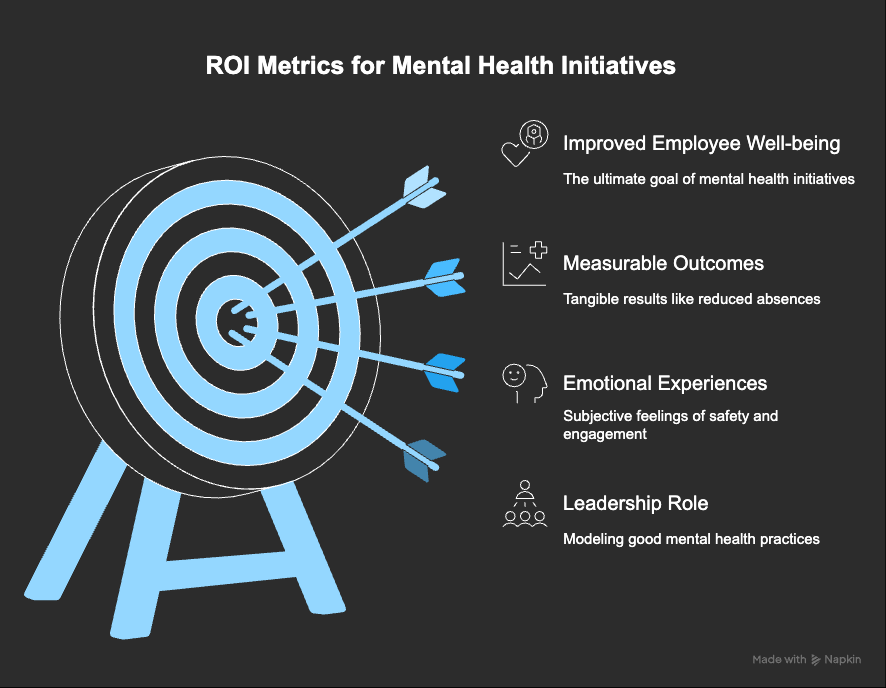
Remember that some ROI metrics are also emotionally experienced. You might reflect on the following questions to assess how certain initiatives are working:
- Do my employees seem more relaxed at work?
- Are people more engaged in meetings or when communicating with one another?
- Has our workplace culture strengthened or improved over time?
- Do people generally feel safe coming to me when they have concerns?
- How do I feel about how our company is honoring employee wellness?
- Am I modeling good mental health practices in the workplace?
Final Thoughts
Regardless of your specific industry, investing in your employees’ well-being is one of the best leadership decisions you can make. Happy, healthy employees are more engaged at work, and they tend to cost the company less overall while simultaneously generating more profit.
That said, mental health interventions can and should evolve with the needs of your company. Taking care of mental health isn’t static- it’s an ongoing process that requires ongoing attention and care.
Sources
- https://www.apa.org/pubs/reports/work-in-america/2023-workplace-health-well-being
- https://www.who.int/news/item/13-04-2016-investing-in-treatment-for-depression-and-anxiety-leads-to-fourfold-return
- https://www.deloitte.com/uk/en/services/consulting/analysis/mental-health-and-employers-the-case-for-investment.html
- https://executive.berkeley.edu/thought-leadership/blog/impacts-poor-mental-health-business
- https://hbr.org/2013/07/employee-engagement-does-more
- https://pmc.ncbi.nlm.nih.gov/articles/PMC9099973


